

As the school year comes to a close, there is a natural shift toward planning.
Conversations turn toward summer projects, professional learning, and the priorities that will shape the year ahead. It is a season of adding.
New ideas. New tools. New opportunities to improve.
But sustainable systems are not built on addition alone.
They are shaped just as much by what we are willing to remove.
In many organizations, systems accumulate over time. A platform introduced to meet a specific need remains in place long after that need has evolved. A pilot becomes permanent. A tool overlaps with something already in use.
None of these decisions are made carelessly. Most are made with good intentions. Each addition solves a problem in the moment. Each brings value when it is introduced.
But rarely do we return with the same level of intention to evaluate what should no longer remain.
Over time, this accumulation creates complexity.
And more importantly, it creates risk.
Not just operational risk, but risk tied directly to the data those systems hold.
Because every system in use is also a system collecting, storing, or transmitting information about students, staff, and the organization itself.
This is where the work of leadership intersects directly with the Culture of Trusted Data.
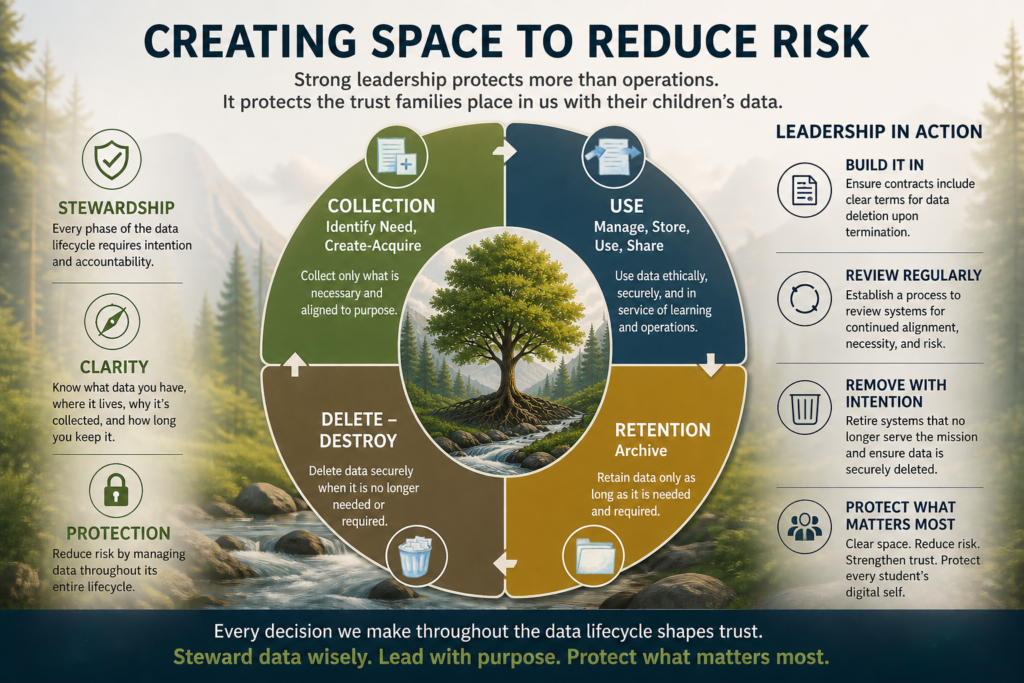
Trusted data is not simply about how information is used. It is about how it is managed across its entire lifecycle. From the moment it is collected to the moment it is no longer needed.
Collection. Use. Retention. Deletion.
Each phase matters.
And each phase requires intentional decisions.
Many organizations have strong processes for adopting new tools. There are review processes. Vetting protocols. Conversations about instructional value and compliance.
But far fewer have equally strong processes for what happens at the end.
- When a system is no longer aligned.
- When a contract expires.
- When a tool is replaced, consolidated, or simply no longer needed.
Without clear expectations and processes, those systems often remain.
And so does the data.
This is where risk grows.
Not because of a single decision, but because of what was never intentionally addressed.
Leadership in this space requires a shift in perspective.
It is not enough to ask, Should we adopt this?
We must also ask, What is our plan when we no longer need it?
That question changes how systems are selected. It changes how contracts are written. And it changes how organizations manage their data over time.
Clear expectations for data deletion upon contract termination are not a technical detail.
They are a leadership decision.
They signal that data is not something to be held indefinitely, but something to be stewarded responsibly.
That same thinking must extend beyond contracts into practice.
There must be a process for regularly reviewing systems. Not just for functionality or cost, but for continued alignment to purpose.
- What is still serving the mission?
- What has become duplicative?
- What remains simply because it has always been there?
These are not always easy conversations.
But they are necessary ones.
Because every system that remains carries both responsibility and risk.
Creating space is not about doing less. It is about making intentional choices that allow the organization to operate with clarity, alignment, and trust.
It reduces complexity.
It strengthens focus.
And it protects what matters most.
Because in the end, leadership is not only defined by what we choose to build. It is also defined by what we are willing to let go.