

The other day, I was in the kitchen trying to get dinner started. Like most nights, I didn’t have enough space. Counters were full, things were half-prepped, and I was moving quickly trying to keep everything going.
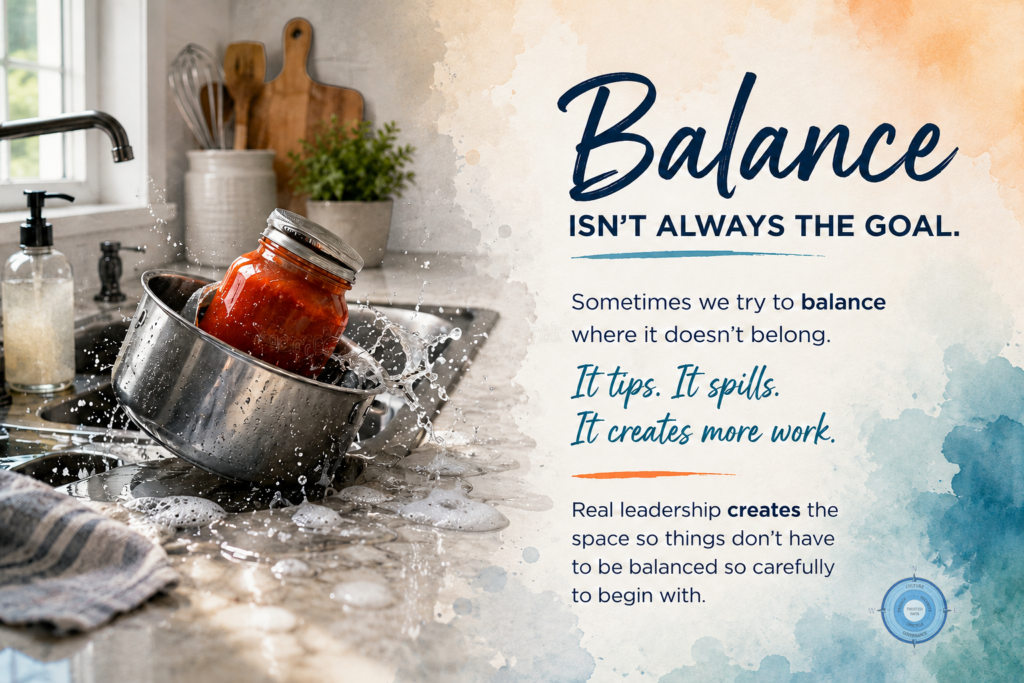
I had a jar of homemade sauce I needed to thaw. Instead of making room, I decided to set it in a pot of warm water balanced in the middle of the sink. I knew it was a little risky, but I had done it before. It worked before.
While washing my hands, I bumped the pot. It tipped, crashed into the sink, and suddenly there was water and soap everywhere.
You would think that would have been enough for me to rethink the setup.
But space was still limited.
So I tried again.
I balanced the pot, set the jar inside, and started filling it with warm water. Before it even had a chance to fill, it tipped over again.
Another mess. Another cleanup.
That was the moment I finally stopped and made space on the counter.
It would have been easier to do that from the start.
But instead, I kept trying to force balance in a place where it didn’t belong.
And as I thought about it, I realized I do this more often than I’d like to admit.
In leadership, we talk about balance all the time.
Work-life balance.
Initiative balance.
Competing priorities.
Limited resources.
But sometimes what we call “balance” is really just us trying to make something work in a space that isn’t designed to hold it.
We don’t have enough time, so we stretch it or insist we can multitask.
We don’t have the capacity, but we stack more on.
We don’t have enough clarity, but we still try to manage everything at once.
And we convince ourselves that if we can just hold it steady long enough, it will work.
Sometimes it does.
But often, it doesn’t.
It spills.
It creates more work.
It forces us to clean up something that could have been avoided if we had just paused and made space in the first place.
Balance isn’t always the goal.
Sometimes the better question is: What needs to change so balance isn’t required here?
Because real leadership isn’t about holding everything together in a fragile state.
It’s about creating the conditions where things don’t have to be balanced so carefully to begin with.