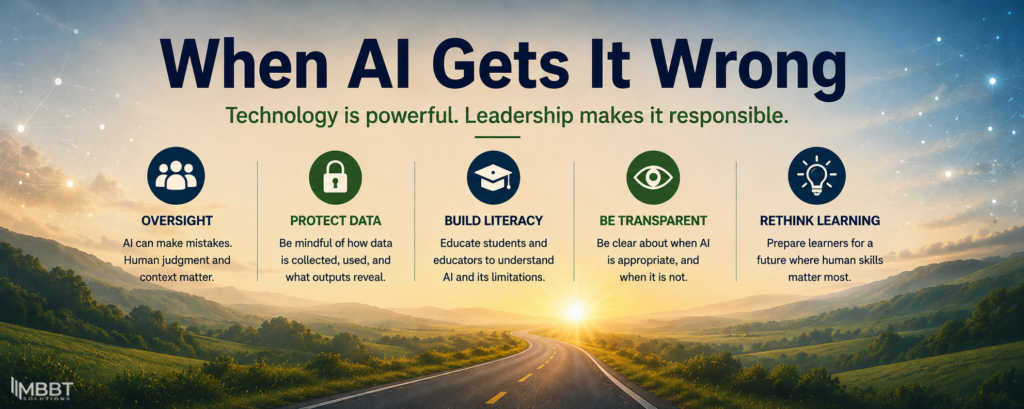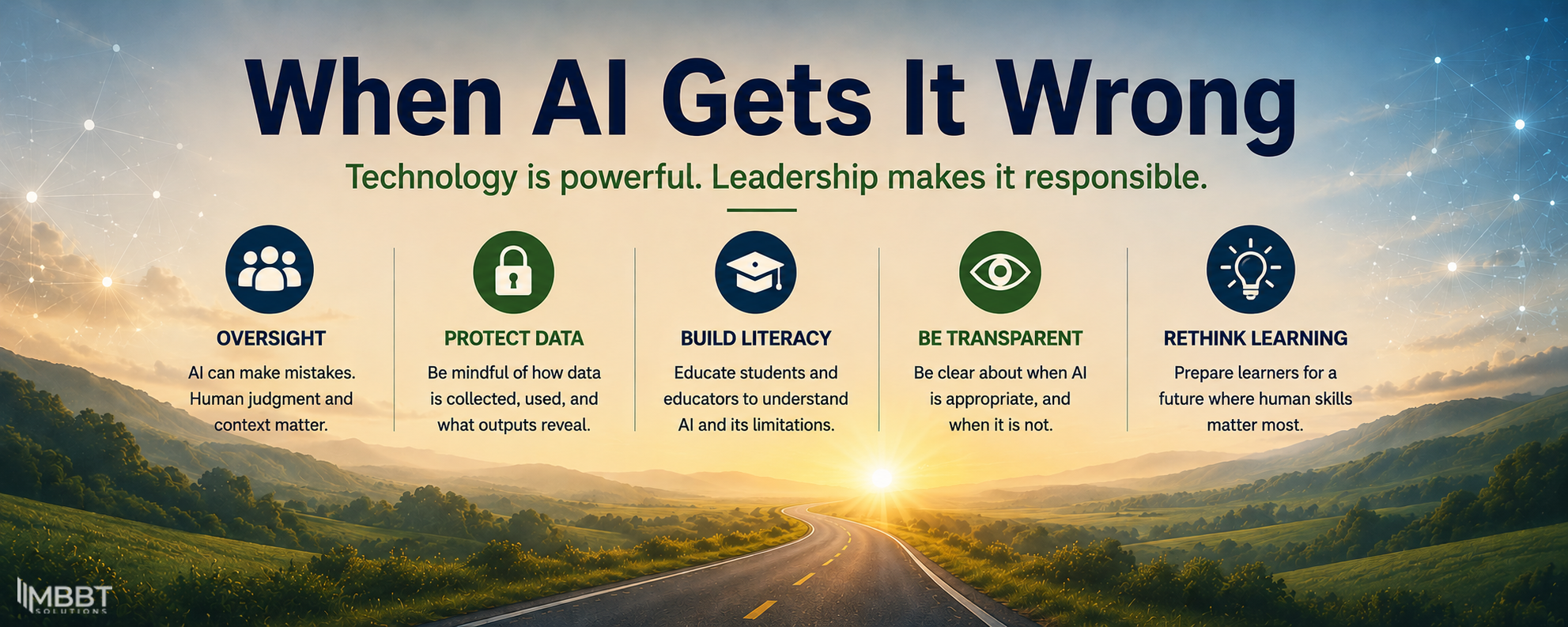
Recent stories about AI systems incorrectly identifying threats, generating false alerts, making inaccurate predictions, and even deleting entire data stores have sparked important conversations about oversight and accountability.
While these examples often make headlines, they highlight a larger leadership challenge:
Who is responsible when AI makes a mistake?
Too often, organizations focus on what AI can do while spending far less time considering how it should be used, monitored, and governed. The result is predictable. When mistakes occur, leaders are left scrambling to determine whether the problem was the technology, the process, or the people responsible for overseeing it. Oftentimes, it’s a combination of the three.
In schools, decisions involving students should never rely solely on automated outputs. Human judgment, context, and professional expertise remain essential. AI can help identify patterns, surface information, and improve efficiency, but it cannot fully understand the complexities of a student, a classroom, or a community.
As districts adopt AI-powered tools for instruction, operations, communication, and safety, leaders must understand not only what the technology can do, but also where its limitations begin.
The most successful organizations are not the ones adopting AI the fastest. They are the ones building the governance, policies, and decision-making structures needed to use it responsibly.
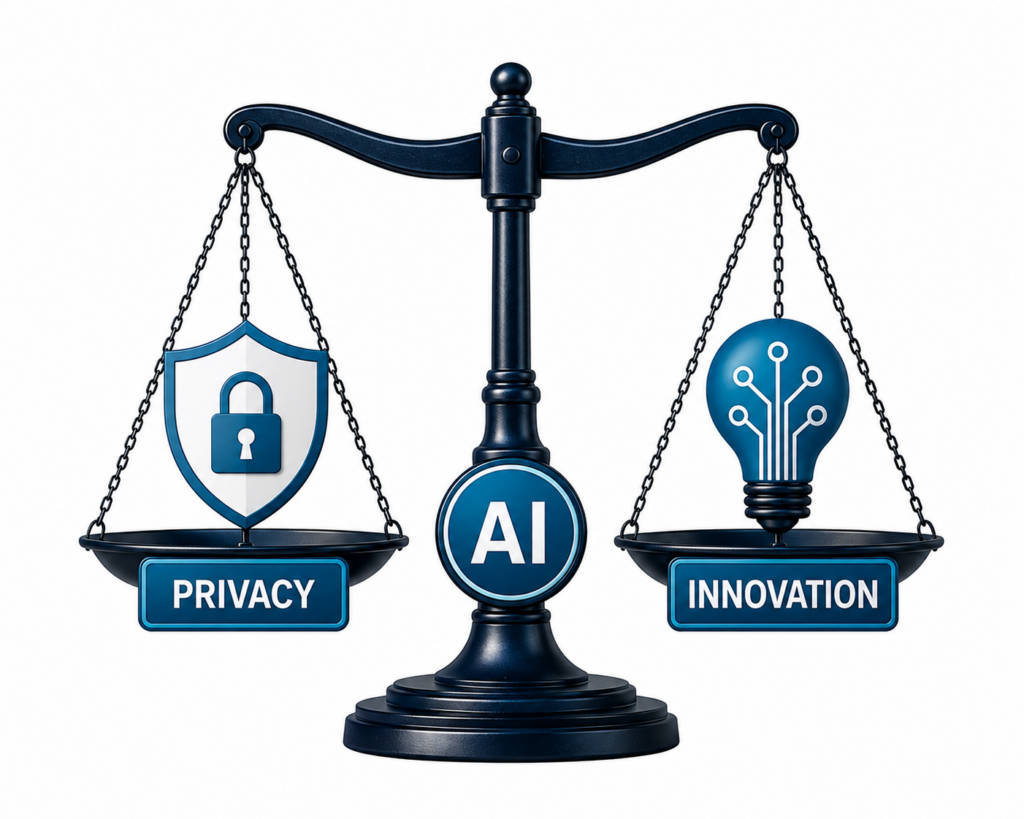
We must begin by asking a few important questions.
How Is Data Being Collected, Used, and Protected?
Every AI system depends on data.
Before implementing a tool, leaders should understand what information is being collected, how it is being used, where it is stored, and who has access to it. Equally important is understanding what happens to the outputs generated by the system.
If an AI tool summarizes student information, analyzes behavior patterns, or generates recommendations, those outputs may contain sensitive information that requires the same level of protection as the original data.
Responsible AI governance extends beyond the inputs. It includes the outputs as well.
Do Students and Educators Understand How AI Works?
AI literacy is quickly becoming a foundational skill.
Students and educators do not need to become computer scientists, but they do need a basic understanding of how AI systems generate responses, identify patterns, and make predictions.
More importantly, they need to understand AI’s limitations.
AI can be persuasive while being completely wrong. It can generate inaccurate information, reflect bias in training data, and present uncertainty with confidence.
Teaching students and educators how AI works empowers them to use it thoughtfully rather than simply accepting its outputs at face value.
Are Expectations Clear?
Many organizations have rushed to develop AI guidance focused on what is prohibited.
Equally important is defining what is encouraged.
- When should AI be used? When should it not?
- What tasks should always require human review?
- What level of transparency should be expected when AI contributes to a product, decision, or communication?
Clear expectations help build consistency, trust, and accountability.
What Does It Mean to Be a Learner?
Perhaps the most important question is also the most challenging.
As AI becomes a routine part of daily life, what does it mean to learn?
For generations, education has focused heavily on acquiring and demonstrating knowledge. While knowledge remains important, AI challenges us to think more deeply about the uniquely human skills that matter most.
- Critical thinking.
- Creativity.
- Communication.
- Ethical decision-making.
- Problem-solving.
- The ability to ask thoughtful questions and evaluate the quality of information.
These skills become even more important in a world where information is abundant and answers are available instantly.
Leading Through the Imperfections
AI will continue to improve, but it will never be perfect.
The goal should not be eliminating every mistake. The goal should be building systems that recognize mistakes, respond appropriately, and keep people at the center of important decisions.
When AI gets it wrong, the question should not be, “Why did the technology fail?”
The better question is:
Did we put the right guardrails, governance, and human oversight in place before we asked it to help?
That is the work of leadership.
And that is the road to safe, strategic innovation.